Sunday, June 5, 2011

Hoi An Ancient Town


The ancient town of Hoi An, 30 km south of Danang, lies on the banks of the Thu Bon River. Occupied by early western traders, Hoi An was one of the major trading centers of Southeast Asia in the 16th century.
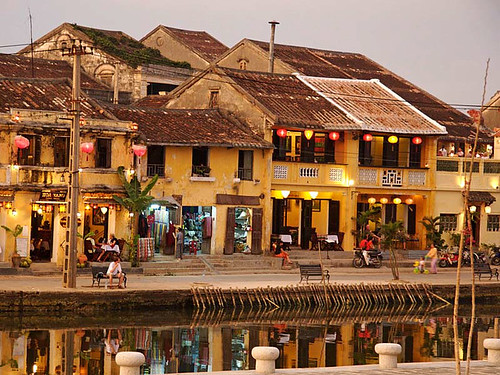
Hoi An has a distinct Chinese atmosphere with low, tile-roofed houses and narrow streets; the original structure of some of these streets still remains almost intact. All the houses were made of rare wood, decorated with lacquered boards and panels engraved with Chinese characters. Pillars were also carved with ornamental designs.

Tourists can visit the relics of the Sa Huynh and Cham cultures. They can also enjoy the beautiful scenery of the romantic Hoi An River, Cua Dai Beach, and Cham Island.

Over the last few years, Hoi An has become a very popular tourist destination in Vietnam.

Light Bright

In a wood-fronted shops a woman in traditional dress sits at a desk, bathed in the light of a lantern made from a simple bamboo fish-trap. Outside, two old men are absorbed in a candlelit game of Chinese checkers. These scenes, straight out of the 19th century, still take place in Hoi An, a sleepy riverside town in the central province of Quang Nam.

Hoi An has long been a cultural crossroad. More than five centuries ago the Vietnamese nation of Dai Viet expanded its territory southwards, encroaching on the Indianized Kingdom of Champa, which covered much of what is now central Vietnam. Hoi An, located on the Hoai River, emerged when Japanese and Chinese traders built a commercial district there in the 16th century.

These diverse cultural influences remain visible today. Visitors will find Hoi An's Old Quarter lined with two-storey Chinese shops, their elaborately carved wooden facades and moss-covered tile roofs having withstood the ravages of more than 300 years of weather and warfare. These proud old buildings, which back onto the river, remind visitors of another era, when Hoi An's market was filled with wares from as far afield as India and Europe. Colourful guildhalls, founded by ethnic Chinese from Guangdong and Fujian provinces, stand quietly, a testament to the town's trading roots.

While Hoi An's old-fashioned charm is always visible, on the 14th of every lunar month modernity takes another step back. On these evenings the town turns off its street lamps and fluorescent lights, leaving the Old Quarter bathed in the warm glow of coloured silk, glass and paper lanterns. In ancient times, Vietnamese people made lamps out of shallow bowls filled with oil. Later, foreign traders introduced lanterns, ranging from round and hexagonal designs from China to diamond and star shaped ones from Japan.

Let there be light

When developing plans to preserve their town's ancient character, Hoi An residents decided to revive the practice of using coloured lanterns. Starting in the fall of 1998, one night each month is declared a "lantern festival". On the 14th day of each lunar month, residents on Tran Phu, Nguyen Thai Hoc, Le Loi and Bach Dang streets switch off their lights and hang cloth and paper lanterns on their porches and windows. Television sets, radios, street lights and neon lights are turned off.

In the ensuing quiet the streets of Hoi An are at their most romantic, the darkness broken only by jeweltoned lanterns in all manner of shapes and sizes.

Strolling through the lantern-lit streets is like walking into a fairytale. It is all the more picturesque since motor vehicles are banned from Hoi An's Old Quarter. On Trai Phu Street, stop at the beautifully preserved Faifo Restaurant to sample some traditional Chinese-style pastries. Or walk on to the Treated Café, where bamboo baskets, commonly used to wash rice, have been transformed into unique lanterns. These basket lamps are but one example of people's creativity as they experiment with new shapes and materials, including lights made from hollow bamboo tubes.

A Warm Glow

The 14th day of the lunar month is a Buddhist day of worship. Residents place offerings of food and incense on their ancestral altars and visit one of Hoi An's many pagodas. The scent of incense and the sounds of people singing add to the town's enchanted atmosphere. On these evenings, visitors will get a rare glimpse into another era. These nights are a welcome reminder of life's unexpected beauty.

Tuesday, May 31, 2011

Sapa, the famous destination in Vietnam


Located in Vietnam's remote northwest mountains, Sapa is famous for both its fine, rugged scenery and also its rich cultural diversity. Sapa is an incredibly picturesque village that lies in the Hoang Lien Son mountain range near the Chinese border in northwestern Vietnam, known as "the Tonkinese Alps". Sapa and its surrounding region is host to many hill tribes, as well as rice terraces, lush vegetation, and Fansipan, the highest peak in Vietnam. However, as a result of a recent surge in popularity Sapa has rapidly become a tourist hotspot where money is the new drug of choice. Don't be put off by the rush, your explorations of the surrounding countryside will be worth the trouble. 

Sapa Town in the northern mountainous province of Lao Cai has been voted one of the world’s top ten spots for walking by popular travel guide Lonely Planet.
The other greatest places for walkers are the Grand Canyon in the US, Aoraki/Mount Cook Village in New Zealand, Lake District in England, Torres del Paine in Chile, Lauterbrunnen in Switzerland, Brecon Beacons in Wales, Kakadu National Park in Australia, Taman Negara in Malaysia, and Dartmoor in England.
According to Lonely Planet, walking can be the best way to experience a place.

Ethnic Minorities


Many ethnic minorities, such as the Hmong and the Dao, live in and around Sapa. Many older women in particular make items such as ethnic-style clothes and blankets, to sell to tourists. Striking up a conversation with them can be very rewarding. Sadly, however, doing this in Sapa town itself will sometimes lead to a scrum as a multitude of vendors taste a potential sale.

Children from these ethnic minorities begin to earn a living as soon as they are five years old. They often peddle small metal or silver trinkets, embroidered pillow cases and friendship bands in the main town, and they walk for about 3 hours from their villages to reach. Some of the "richer" ethnic women sometimes take a one-hour motorbike ride back to their villages at the end of the day.

Girls as young as ten years old can get married and often have two children by the time they are 20 years old. This is especially the case for the more beautiful ones. Poverty has led to a majority of girls who leave their villages each day to go to Sapa town and to have only one meal per day.

Weather
In winter (the 4 months November to February), the weather in Sapa is invariably cold, wet and foggy (temperatures can drop to nearly freezing). Travellers have rolled into town on a glorious clear day and proceed to spend a week trapped in impenetrable fog. When it like this there really isn't very much to do. Also the rice paddys are brown & empty (they are planted in spring), the paths very muddy & slippery & the glorious vistas of summer are completely hidden in the mist. If you chose to visit in winter, bring along warm clothes or prepare to be cold and miserable, as many hotels do not have efficient heating in their rooms. During that time, more upmarket hotels that do have heating fill up quickly, so make advance reservations if you can afford not to freeze. (Or don't go there in winter time). It rains very often during the month of August, especially in the mornings.

Tuesday, May 24, 2011

Nha Trang - one of the most beautiful bays of the world

The city of Nha Trang is becoming more popular with the tourists in recent years. Yet, with a population of 300,000, Nha Trang still retains its small town atmosphere. This resort town is well known for its miles of beach and the friendliness of its people. The city is flanked by nearly ten kilometers of prime beach where the water is warm year round. The average temperature in Nha Trang is 26 C. Nha Trang also has the lowest level of humidity in all of Vietnam. Today, Nha Trang ranks among the top of all beaches in Vietnam. Nha Trang is 1,287 km south of Hanoi, 624 km south of Hue and 442 km from Ho Chi Minh city (Saigon). Nha Trang has several famous islands. Most notable are Hon Tre, Hon Yen, Hon Rua and the Spratly islands.

The name Nha trang is a Vietnamese pronunciation of a Cham word Eatran or Yjatan. Ea or Yja means river, and tran means reed. According to the locals, there once were a lot of reeds along Ngoc Hoi river. The river winds its way through the town. Ngoc Hoi was later renamed Nha Trang river.

Another theory of the origin of Nha Trang's name has a more amusing twist. Long ago, in this part of the country, all the houses were made out of the reeds and mud gathered from Ngoc Hoi river. The only house that was made out of bricks were the house belonging to Dr. Yersin, a French immunologist who made his home here. The house itself was painted prominently white and could be seen by vessels coming from far away. Once there was a foreign vessel passing by. The captain asked his translator where he was. The translator not knowing where they were blurted out Nha` tra('ng or white house in Vietnamese. The captain duly noted on his chart Nha Trang. Because most foreign languages do not make use of tones, the captain's name for this part of the country stuck.

Monday, May 23, 2011

Po Nagar Cham Towers

 Location: Po Nagar Cham is situated on Cu Lao marble hill, 2km north of Nha Trang, in Khanh Hoa Province.
Characteristic: Po Nagar Cham Towers were built between the 8th and 13th centuries. The largest of the four remaining towers was built in honour of the Goddess Po Nagar, also known as Lady Thien Y Ana or Lady Mother of the Kingdom.

She spent part of her life in teaching new weaving and agricultural techniques. The 22.5m tower contains her sandstone statue sitting cross-legged on lotus-shaped stone estrade. The statue is 2.6m high (including the Yoni-shaped stone pedestal). The statue has ten hands, eight of which each holding a specific object illustrating the intellect and power of her. The remaining towers were dedicated to different gods: the southeast tower, the northwest tower and the south tower.

Not only are the towers famous for their architecture and sculpture, but they are also well-known for their great significance in history, nationalism, and archaeology.

Other towers in the complex are dedicated to gods - the central tower is in honour of Cri Cambhu, and is thought to bless devotees with fertility, so is visited by childless couples. In the North West lies a tower dedicated to Sandhaka, a wood cutter and foster father to Ponagar, and the tower in the south was dedicated to Ganeca, the daughter of Ponagar.

Entrance to the towers costs 12,000 VND and opening hours are from 6 AM - 6 PM. Late afternoon is a good time to visit.

Thursday, May 19, 2011

Con Dao Islands - natural beauty

One of the stellar attractions in this region, the Con Dao Archipelago is slowly gaining attention for its startling natural beauty. Con Son, the largest of this chain of 15 islands and islets, is ringed with lovely beaches, coral reefs and scenic bays, and remains partially covered in thick forests. In addition to hiking, diving and exploring empty coastal roads and deserted beaches, there are some excellent wildlife-watching opportunities.

Con Son Island (with a total land area of 20 sq km) is also known by its Europeanised Malay name, Iles Poulo Condore (Pulau Kun-dur), which means ‘Island of the Squashes’. Although it seems something of an island paradise, Con Son was once hell on earth for the thousands of prisoners who languished in confinement during the French and American regimes.

Roughly 80% of the land area in the island chain is part of Con Dao National Park, which protects Vietnam’s most important sea turtle nesting grounds. For the last decade the World Wildlife Foundation (WWF) has been working with local park rangers on a long-term monitoring program. During nesting season (May to September) the park sets up ranger stations to rescue threatened nests and move them to the safe haven of hatcheries.

Other interesting sea life around Con Dao includes the dugong, a rare and seldom-seen marine mammal in the same family as the manatee. Dugongs live as far north as Japan, and as far south as the subtropical coasts of Australia. Their numbers have been on a steady decline, and increasingly efforts are being made to protect these adorable creatures. Major threats include coastal road development, which causes the destruction of shallow-water beds of seagrass, the dugongs’ staple diet.

Con Dao is one of those rare places in Viet­nam where there are virtually no structures over two storeys, and where the traveller’s experience is almost hassle-free. There’s even no need to bargain at the local market! Owing to the relatively high cost and the inaccessibility of the islands, mass tourism has thankfully been kept to a minimum.

These days most visitors to Con Son are package-tour groups of former VC soldiers who were imprisoned on the island. The Viet­namese government generously subsidises these jaunts as a show of gratitude for their sacrifice. Foreign tourists are still few and far between, though their numbers are on the rise.

The driest time to visit Con Dao is from November to February, though the seas are calmest from March to July. The rainy season lasts from June to September, but there are also northeast and southwest monsoons in autumn that can bring heavy winds. In November 1997 typhoon Linda did a number here: 300 fishing boats were lost, reefs were wiped out and the forests flattened. September and October are the hottest months, though even then the cool island breezes make Con Dao relatively comfortable when compared with HCMC or Vung Tau.
(Source: Lonelyplanet)

Tuesday, April 12, 2011

A trip to Phu Quoc National Park


In recent years, Phu Quoc National Park in Kien Giang Province has become an ideal eco-tourist destination. It has special and unique biodiversity values compared to other national parks across the country.

Situated in the North-East of Phu Quoc Island and have the Northern and Eastern boundaries with the coastline, Phu Quoc National Park covers of 31,422 ha, accounting for 70% area of Phu Quoc Island, which is regarded as a precious thanks to the prosperity of natural beauty.
According to director Pham Quang Binh, Phu Quoc National Park is located on an island that has a mixture of continental and coastal climate, creating a rich ecosystem of primeval, secondary and indigo forests. Its indigo forests are distributed in the wetlands or the lowlands that is flooded in the rainy season and sloping hills.
The topography of the national park is hilly, although not particularly steep with the highest point is Mount Chua, at 603 m. Being drained by numerous, mainly seasonal, streams, the only sizeable river on the island is the Rach Cua Can river, which drains the southern part of the national park, and flows into the sea on the west coast of the island.
Covering more than 27,000 ha of forest, included 6,000 ha of buffer land and 20,000 ha of surrounding ocean area, Phu Quoc National Park has a rich ecosystem due to the co-existence of the Malaysian, Burmese and Himalayan species.
In term of the flora, Phu Quoc National Park is the idea environment for more than 470 species of plants and several types of coral reefs offshore. Phu Quoc Island is lowland evergreen forest and the national park supports 12,794 ha of forest, equivalent to 86% of the total area. To date, 929 plant species have been recorded on Phu Quoc Island. At lower elevations in some areas, the national park supports distinctive formations of Melaleuca - one kind of trees that the leaves are evergreen, alternately arranged, dark green and grey-green in color.
As regards to the fauna, a list of 43 mammal species belonging to 18 families and 6 orders was compiled in here. Among these recorded species, 6 species are listed in the Red Data Book of Vietnam (2000), 6 species in the 2005 IUCN Red list and 11 species in the Governmental Decree 32/2006/ND-CP. Silvered langur, slow loris, pygmy loris, crab-eating macaque, stump-tailed macaque, small-clawed otter and fruit bats are species of the most conservation concern. Besides, due to the extremely plentiful coral reefs in the south of the island, there are 125 species of fish, 132 species of mollusc and 62 species of sea weed. Interestingly enough, Phu Quoc is also one of the two places in Vietnam where the Dugong, a marine species on the brink of extinction can be found.
Conservation aspect.
In 2001, the Government decided to upgrade the park to preserve its ecology, and then the Park Management Board has coordinated with local residents and military units to implement forest protection measures, particularly fire prevention.
“The rainy season in Phu Quoc is short but the dry season is longer there. So, we have established a forest fire prevention steering board and firefighter units which are on standby,” said Mr. Binh – director of the park. “Every commune and local military unit has worked out detailed fire prevention plans. We also have regular communications with local residents to raise their awareness of forest protection.”
Relax with activities.
Visiting Phu Quoc, travellers can have chance for sightseeing of historical sites; admiring with veneration beauty spots of streams, forests, caves and grottoes, beaches, coral reefs and mountains, etc. as well as visiting the villages famous for making sauces and know about a special species of Phu Quoc dog.
Phu Quoc National Park is a good destination for tourists as it offers a wide range of activities such as camping and trekking. It’s also ideal for those who want to study the tropical forest. As Phu Quoc develops into Vietnam’s ecotourism capital, the jewel in its crown, the park will become ever more attractive to visitors from around the world.

Thursday, April 7, 2011

A tranquil destination for visitors!


Located in Soc Trang Province, Doi Pagoda is attractive not only for its beautiful architecture but also for its very large roof that houses millions of bats.
It is said that Doi Pagoda (Bat Pagoda) was built during the 16th century, and it has been renovated several times since. It is the forth oldest pagoda in Soc Trang township. From the gate, the pagoda, built by the Khmer, attracts passersby with skilful, symbolic decorations on its pillars and roof, reproducing Khome art. The walls are also covered with large paintings. Other halls in the pagoda are decorated with sophisticated designs and paintings depicting story of the Buddha. The windows are small, casting a mesmerising light inside that is particularly good for photography. Of the 600 Khmer pagodas in the Cuu Long (Mekong) River Delta, Doi Pagoda is so famous that regular tours from Ho Chi Minh City City, Can Tho and Ca Mau visit Soc Trang township. It was even featured on the TV show, Vietnam Guinness Records. The pagoda is located in a lush garden and a pointed tower sits at the summit. In the sunlight after a heavy downpour, the pagoda emerges with four snake-head shaped roofs hand-carved with masterful skill. On each support pillar, a Kemnar statue clasps her hands as if to welcome visitors. Inside the pagoda, soot-blackened statues keep mournful watch; a full year after the fire, the pagoda remains un-repaired. An ancient Buddha statue and a prayer-book written on palmyra leaves can be admired here. In 1999, Doi Pagoda was recognized as a national historical treasure.
The pagoda is known among domestic and international tourists as a "Mecca" for bats, which provide fertiliser for local farmers. The bats in the pagoda cling to tree branches all day, then fly away at dush to seek food, and usually home by four the next morning. Small bats always cling to their mother, even in the search for food. If visiting the pagoda, you can see bats hanging upside down from branches like over-ripe fruit. May to August is breeding season. Those visiting the pagoda at this time of year are expected to walk quietly for fear a sudden noise may startle a bat mother into dropping her child. The bats in the pagoda are actually flying-foxes. A new-born weighs 0.5kg with a wing span of about 50cm. Mature bats can weigh 1.5kg with a wing span of 1.5m. According to the monks, the flying-fox appeared at the pagoda 200 years ago. Interestingly enough, the presence of the bats has not affected the plants growing in and around the pagoda, they never eat the fruit in the garden.
Doi Pagoda with a large space for trees, making it a tranquil place to sit, is one of the best tourist attraction in Soc Trang. Watching the bats take to the skies, it will occur to you that the pagoda is a unique natural reserve. Though neither large nor particularly exquisite, all who hear of it wish to visit...